
Archbishop Mpundu’s Final Witness: A Coffin on the Floor
By Louis Mwape
Besides attending the requiem Mass of Archbishop Telesphore George Mpundu, I visited St. John Paul II Chapel at the Cathedral of the Child Jesus to sign the book of condolences—to mourn, to pray, and to give thanks for the gift of his life.
I found long queues of people waiting patiently to sign. It was evident that many had much to say about him—for good reason. A voice that was sometimes lone yet always courageous, Archbishop Mpundu stood firm against injustice. The man laid to rest today was a presence of hope and a light in critical times.
Politicians, Catholic leaders from across the region, and the faithful—both prominent and ordinary—gathered in unity to honour his life and legacy. He was a towering figure, long regarded as a devoted pastor and a courageous champion of social justice.
Throughout his 54-year pastoral ministry, Archbishop Mpundu rose to the occasion whenever the Church’s moral voice seemed to waver. He remained steadfast, a shepherd guided by truth and conscience.
As Archbishop Alick Banda expressed in his homily:
“We thank God for the life of Archbishop Mpundu, a shepherd dedicated to serving God and His people. We thank God for a ministry characterised by courage in defending the weak, humility in his unassuming nature, wisdom in reading the signs of the times, and faithfulness to the Gospel.”
A Striking Simplicity: A Funeral with a Message
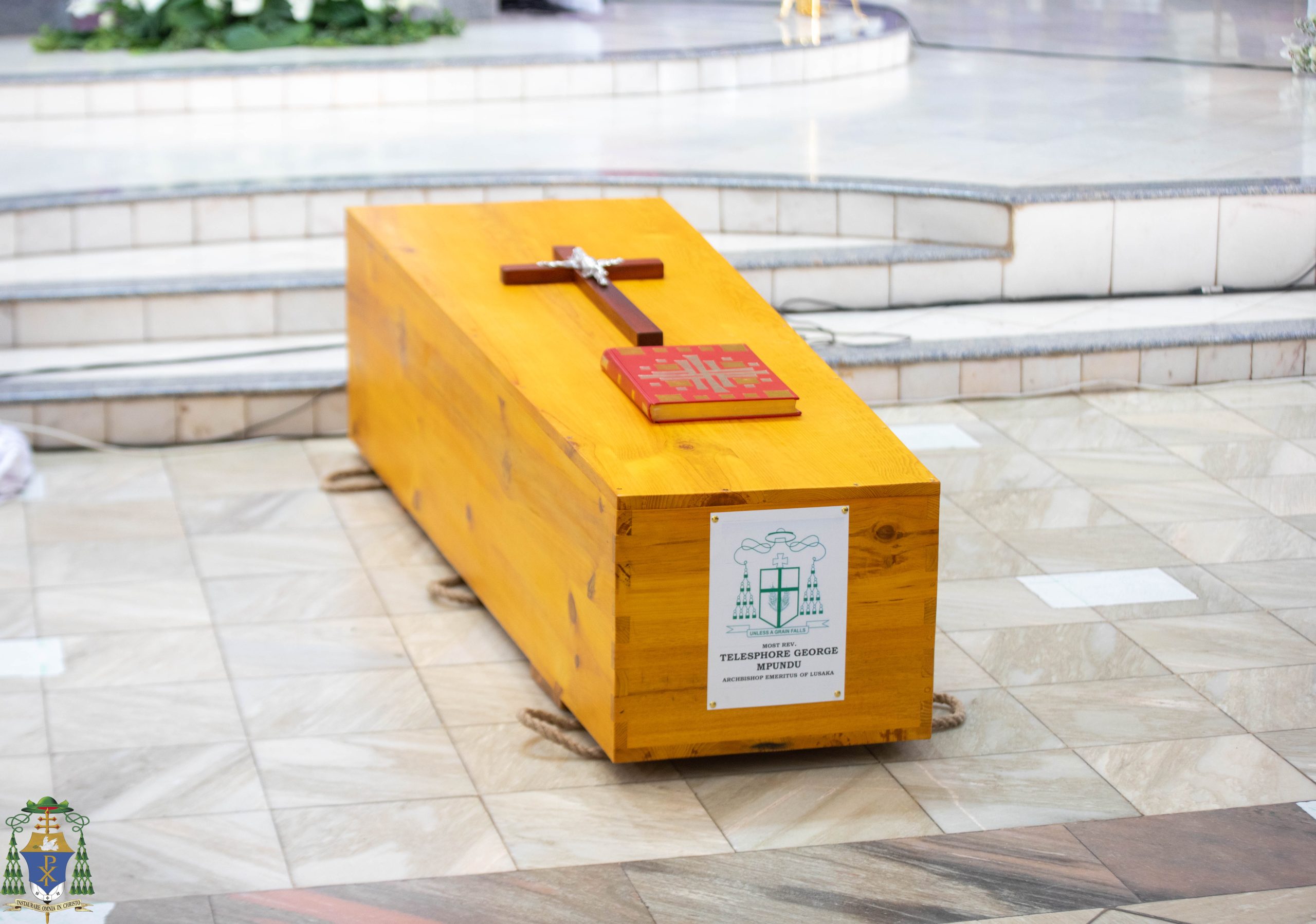
I have witnessed many priests and cardinals buried with grandeur—glass caskets, raised biers, and elaborate processions marked by pomp and splendour. In contrast, Archbishop Mpundu’s funeral bore none of these. His was a simple wooden coffin, carried by pallbearers and later placed on the floor.
This simplicity spoke volumes.
The requiem reflected his understanding of episcopal ministry—not as a position of worldly power, but as humble pastoral service. His final witness echoed the spirit of simplicity often associated with Pope Francis, the “People’s Pope.” Like Pope Francis, Archbishop Mpundu embraced a life free from excess, rooted in humility and closeness to ordinary people.
It was as though Archbishop Mpundu was fulfilling what John the Baptist taught; “he must increase and i must decrease” John 3:30-35.
Priests must not be the centre but signposts leading the faithful to Christ and that our bishop embraced.
Fr. Arthur, in recounting the archbishop’s biography, affirmed this simplicity:
“He was a man completely detached from material wealth. He did not maintain a personal bank account; any gifts or money he received were channelled directly into diocesan accounts.”
Even in death, his life continued to preach.
A Lesson in Leadership, Unity, and Moral Courage
Archbishop Mpundu belonged to the Church and, in a profound sense, to everyone—for a priest is ordained for all. Like any person, and like many prelates of his stature, he may have had personal wishes regarding his burial. Yet what stood out was the unity with which his funeral arrangements were carried out.
There was no public viewing of the body. Whether this was explicitly his wish or a pastoral decision made collectively, it was respected without dispute. The harmony between his known values and the decisions of his successors was itself a powerful testimony.
In every situation, no matter how delicate, unity and balance are possible. Perhaps one of the great strengths of the Catholic Church lies in the richness and clarity of its rites—providing guidance that fosters order, dignity, and shared understanding.
A Man of Conscience
In one of the archived interviews that recently resurfaced, the late Ben Kangwa once challenged him:
“What kind of a man are you? You fought Kaunda; FTJ came, you fought him; Mwanawasa came; Sata—your own—you fought; and now Edgar Lungu. What kind of a man are you?”
The answer, perhaps, is now clearer: he was a man of conscience.While not without human shortcomings, Archbishop Mpundu was deeply committed to justice. He spoke out not for himself, but for what was right. His courage was not selective—it was principled.
A Final Tribute
Like Shakespeare mourning his father, I conclude this reflection with fitting words:
“He was a man, take him for all in all.I shall not look upon his like again.”
May his soul, and the souls of all the faithful departed, through the mercy of God, rest in peace.